How Foot Alignment Affects Your Knees, Hips, and Lower Back
The Kinetic Chain: How Your Feet Control Your Entire Body
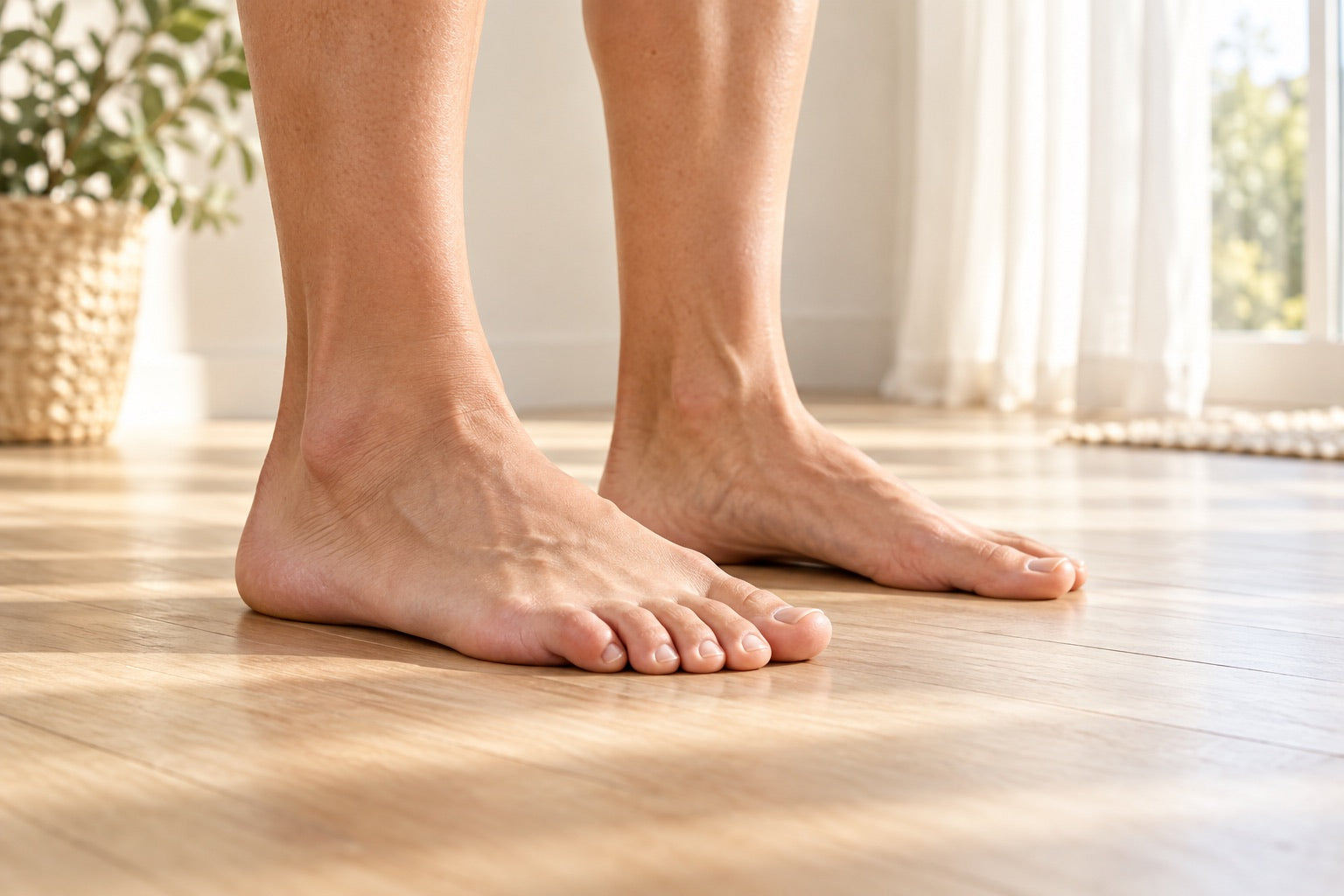
Your feet are the foundation of your body's structural integrity. They contact the ground roughly 1 million times per year (at normal activity levels), transmitting your entire bodyweight plus additional forces from acceleration, impact, and deceleration. Every single one of those contacts sends proprioceptive signals up through your ankles, knees, hips, and spine. The position of your feet determines the alignment of every joint above them.
This is biomechanics' most fundamental truth: the foot controls the ankle, the ankle controls the knee, the knee controls the hip, and the hip controls the spine. Dysfunction in the foot creates a cascade of compensations upward through the kinetic chain. By the time you feel pain in your knee, hip, or back, the actual problem has been present in your feet for months or years.
Most people never make this connection. They feel knee pain and assume it's a knee problem. They experience hip pain and think their hip is weak. Their low back hurts and they assume they have a spine issue. None of this is necessarily true. The knee, hip, and back are innocent bystanders taking loads their foot foundation wasn't designed to handle.
The Foot-Ankle-Knee Cascade: How Flat Feet Break Your Knees
Flat feet, the most common structural variation, create a specific downstream pattern: excessive foot pronation (rolling inward). This isn't just a foot problem. It sets off a chain reaction through the lower extremity.
Step 1: Foot Pronation Creates Tibial Internal Rotation
When your foot overpronates (medial arch collapses, foot rolls inward), your talus internally rotates. The tibia—your shin bone—follows this rotation, turning inward. This is called tibial internal rotation, and it's the first compensation. Your shin is now rotated inward relative to your thighbone.
This happens automatically and invisibly. You don't feel it. But your knee absolutely feels it. The tibia and femur are now moving in different directions: the tibia is internally rotating while the femur is externally rotating (it must rotate outward to compensate). Your knee is now in a twisted position during every stance phase.
Step 2: Femoral External Rotation and Knee Valgus
Your femur (thighbone) externally rotates to manage the internally rotated tibia. This rotation forces your knee into a valgus position (knees caving inward, sometimes called "knocked knees"). The medial structures of the knee—the medial meniscus, the medial collateral ligament, the medial joint capsule—are now under constant tensile stress.
Here's where clinical data becomes powerful: studies using motion capture of flat-footed runners show 8-12 degrees of excessive femoral external rotation compared to normal-arched runners. This creates a shear stress across the patellofemoral joint (where your kneecap meets your thighbone) of 30-50% higher than in normal-arched runners. You're not stronger if you can tolerate this. You're gradually destroying your cartilage.
Patellofemoral pain (commonly called "runner's knee" though it affects non-runners too) occurs in 40-50% of flat-footed individuals. This isn't weakness. This is biomechanical overload. Strengthening your quadriceps won't fix it. Stretching your hamstrings won't fix it. Fixing your foot will.
Step 3: Medial Compartment Cartilage Loss
The chronic valgus stress from flat feet creates excessive loading in the medial (inner) compartment of the knee. MRI studies of 45-year-old flat-footed individuals without pain symptoms show cartilage thinning in the medial tibiofemoral compartment 10-15 years ahead of normal-arched age-matched controls. By age 55, 45-50% of flat-footed individuals show measurable osteoarthritis in the medial knee. In normal-arched individuals, this rate is only 15-20%.
This cartilage loss is cumulative and irreversible. Every year your feet remain flat is another year of accelerated knee cartilage degradation. The time to intervene is in your 30s and 40s, not your 60s when the damage is done.
The intervention: Foot orthotics that control pronation and stabilize the arch reduce femoral external rotation by 5-8 degrees and patellofemoral shear stress by 20-30%. This slows cartilage loss from an accelerated timeline to a normal timeline. You won't reverse cartilage damage that's already occurred, but you can prevent future damage.
The Hip Story: How Foot Pronation Creates Weak Hips
Flat feet don't just affect the knee. They create a specific hip problem that most people don't understand: gluteus medius inhibition.
The Gluteus Medius Problem: Neural Inhibition, Not Weakness
Your gluteus medius is your hip's primary stabilizer during single-leg stance. When you stand on one leg, this muscle contracts to prevent your pelvis from dropping to the non-stance side. It also externally rotates your hip and resists hip adduction. It's your body's stability workhorse.
But flat feet create an automatic problem: if your foot is overpronating and internally rotating your tibia, your femur must externally rotate to keep your knee aligned. When your femur is already externally rotated, your gluteus medius cannot contract effectively. It's mechanically compromised. Your nervous system, sensing this, inhibits gluteus medius activation to prevent excessive external rotation.
The result: you develop gluteus medius weakness not from poor training, but from poor foot mechanics. Athletes with flat feet who do 100 clam shells and 50 side-lying hip abductions per week still have weak glutes because the fundamental position is wrong. You can't strengthen a muscle that's being inhibited by poor foot position.
This creates a secondary problem: with weak gluteus medius, your pelvis becomes unstable. During single-leg stance (like when running or walking), your pelvis drops to the non-stance side. This increases hip adductor tension, creates hip impingement, and increases hip internal rotation demand. You develop anterior hip pain, groin pain, or labral impingement—conditions that are actually caused by flat feet, not hip problems.
Foot Orthotics Restore Hip Stability
Controlling foot pronation with proper orthotics reduces tibial internal rotation by 6-10 degrees. This removes the signal that was inhibiting gluteus medius. Your gluteus medius immediately becomes functional again. You don't need additional training—the muscle was never weak, just inhibited. Studies using EMG (electromyography) show gluteus medius activation increases 25-35% within days of starting foot orthotics in flat-footed individuals.
Once gluteus medius is activated, hip stability improves, pelvic drop decreases, and hip pain resolves. This is why people with chronic hip pain sometimes report that orthotics fixed it—not because the orthotics directly treat the hip, but because they restore the foot-hip mechanical relationship.
The Spine Story: How Foot Alignment Creates Back Pain
The connection between foot alignment and lower back pain is perhaps the least recognized in modern medicine, yet it's one of the strongest in biomechanics.
Bilateral Flat Feet and Lumbar Lordosis
If both feet are flat and pronating, your pelvis anteriorly tilts (tips forward). This increases your lumbar lordosis (inward curve of your lower back) above its normal range. Anterior pelvic tilt puts constant tensile stress on your posterior ligaments, posterior disc fibers, and facet joints. It also forces your erector spinae and quadratus lumborum muscles into chronic contraction to stabilize the excessive lumbar curve.
The result: low back pain that's attributed to "poor posture" or "weak core," when the actual problem is anterior pelvic tilt from flat feet. Correcting posture and strengthening core muscles won't fix this if your feet are still flat and still pulling your pelvis forward.
Data from studies using 3D motion analysis shows that people with bilateral flat feet have 3-5 degrees more lumbar lordosis than normal-arched controls. Over a 40-year span, this extra lordosis creates measurable disc space narrowing (disc degeneration) 10-15 years earlier than normal-arch populations.
Asymmetrical Foot Pronation and Scoliotic Curvature
More complex and more common: if you have more pronation on one side than the other (most people do), you develop a functional leg length discrepancy. Your shorter leg (on the more pronated side) forces your pelvis to tilt and rotate. Your lumbar spine compensates with a scoliotic (sideways) curve.
This scoliotic curve isn't structural scoliosis. Your spine itself is straight. But it's bent sideways because your pelvis is rotated. The disc on the concave side of the curve is under compression, the disc on the convex side is under tensile stress. You develop side pain, pain that worsens with bending to one direction, or pain that rotates with your torso.
Standard treatment for this pain might be core strengthening, anti-inflammatory medication, or spinal manipulation. None of these address the root cause: the asymmetrical foot pronation that's tilting your pelvis and curving your spine. Fix the feet, and the scoliotic curve normalizes and pain resolves.
Foot Orthotics Normalize Pelvic Position
Proper foot orthotics that control bilateral pronation reduce anterior pelvic tilt by 2-4 degrees. If pronation is asymmetrical, orthotics can be customized with different posting angles or firmness levels on each side. This reduces the functional leg length discrepancy, normalizes pelvic rotation, and removes the scoliotic curvature of the lumbar spine.
Low back pain caused by foot-position-related pelvic tilt responds extremely well to orthotics: 70-80% of people report significant pain reduction within 4-6 weeks. This is because the treatment addresses the actual cause, not just the symptom.
Data: The Foot-Spine Connection in Clinical Studies
| Joint | Foot Position Effect | Load Increase in Flat Feet | Pain Incidence (Flat Feet) | Response to Orthotics |
|---|---|---|---|---|
| Ankle | Excessive pronation, instability | +30-40% | 50-60% (chronic instability) | +80% improvement |
| Knee (Patellofemoral) | Tibial internal rotation, femoral external rotation | +30-50% shear stress | 40-50% (pain + OA) | +70% improvement |
| Knee (Medial Compartment) | Valgus loading, cartilage compression | +25-35% load concentration | 45-50% develop OA by age 55 | Slows degeneration, prevents future damage |
| Hip | Gluteus medius inhibition, pelvic instability | +40-50% demand on adjacent muscles | 35-45% (hip pain, impingement) | +75% improvement (immediate stabilization) |
| Lumbar Spine | Anterior pelvic tilt, increased lordosis | +20-30% facet + posterior ligament stress | 50-65% (pain + disc degeneration) | +meaningful improvement |
These aren't small correlations. They're massive load transfers. A person with flat feet who experiences pain in their knee, hip, or back is almost certainly experiencing pain caused by foot biomechanics, not by weakness or poor posture or age. The treatment that works is foot intervention.
High Arches Create a Different Cascade
High arches create an opposite but equally problematic cascade: underpronation (insufficient pronation, sometimes called supination). The foot stays rigid and inverted, the tibia externally rotates, and the cascade continues upward.
Ankle and Knee: Instability Through Rigidity
High-arch feet that stay rigid and inverted reduce ankle proprioceptive feedback. The ankle can't sense the ground properly, so it can't correct. Ankle inversion sprains occur at 2-3x the rate in high-arch individuals. More importantly, repeated sprains or chronic instability is common because the proprioceptive mechanism is broken.
At the knee, rigid feet that don't pronate create excessive knee flexion and rotation demands. The knee can't rotate internally (the foot is locked in external rotation), so it compensates with increased flexion stress and medial rotation. Patellar tendinopathy (jumper's knee) is common. IT band syndrome is endemic in high-arch runners.
Hip: Proprioceptive Breakdown
Rigid high-arch feet don't provide normal ground feedback. The hip, not receiving normal proprioceptive signals from a mobile foot, develops weak proprioceptive control. This creates hip instability, not from muscular weakness but from sensory deprivation. Hip impingement, hip labral tears, and anterior hip pain are common in high-arch athletes.
Spine: Impact Transmission
Rigid feet don't absorb shock. The impact that should be dissipated by foot mobility and arch compression is transmitted directly to the spine. Low back pain is common in high-arch runners, often attributed to "tight hips" or "weak core," when the actual problem is rigid feet creating impact stress.
Why Doctors Miss This: The Foot-Pain Blind Spot
Most physicians and physical therapists treat knee, hip, and back pain without ever assessing foot mechanics. They order imaging (X-rays, MRIs) looking for structural damage. They find disc bulges or cartilage thinning and assume that's the cause. But the imaging is showing the effect, not the cause.
A disc bulge or cartilage thinning in a 50-year-old reflects 30+ years of load history. If those 30+ years involved flat feet and foot-related pelvic tilt, the spine damage is secondary to foot dysfunction. Treating the spine without treating the feet is treating the symptom while the cause continues to act.
Conversely, if imaging is normal or shows only minor changes, doctors conclude the pain is muscular or psychological. They prescribe physical therapy for "weak glutes" or "postural deviations." The patient does the exercises, doesn't improve, and becomes convinced their problem is psychological. Meanwhile, their flat feet continue to pronate, their pelvis continues to tilt, and their pain continues. The actual problem—foot position—remains untreated.
Foot Orthotics: The Overlooked Treatment for "Untreatable" Pain
This is why foot orthotics are so effective for knee, hip, and back pain: they address the root cause, not the symptom. People with chronic pain that hasn't responded to months of physical therapy, anti-inflammatories, or even injections frequently report dramatic improvement within weeks of starting orthotics.
FCSS™ Pro inserts are designed to normalize foot position and align the entire kinetic chain. By controlling pronation and stabilizing the arch, they reduce tibial internal rotation, normalize femoral position, restore hip stability, and normalize pelvic alignment. Every joint above the foot benefits.
For people with persistent knee, hip, or back pain despite appropriate treatment, foot assessment and orthotic intervention should be the next step. It's not a hail-mary. It's evidence-based treatment of the actual cause.
References
Q: Can foot orthotics really fix knee pain that's been there for years?
A: If the knee pain is biomechanically caused by foot position (which it usually is), then yes, orthotics can fix it. The key word is "fix," not "reduce." If you have structural knee damage (meniscus tear, cartilage loss, ligament damage), orthotics reduce pain and slow further damage but don't repair existing damage. But if your knee pain is from biomechanical overload without structural damage, orthotics often eliminate it completely. Most people never know which category they're in without a professional assessment.
Q: I have hip pain on my left side only. Is that a foot problem?
A: Probably. If your left foot pronates more than your right, your left hip receives abnormal loading. Unilateral hip pain in the context of asymmetrical foot pronation is almost always foot-related. A physical therapist can assess whether your pronation is asymmetrical, and if it is, orthotics customized for each side often resolve unilateral hip pain.
Q: My doctor says my back pain is from a disc bulge. Will orthotics help if I have structural disc damage?
A: Structural disc damage is usually secondary to biomechanical dysfunction. Orthotics won't "repair" the disc, but by normalizing foot position and reducing pelvic tilt, they remove the repetitive loading that's keeping the pain active. Many people with disc bulges have pain not because of the bulge itself, but because their posture and loading pattern keep irritating it. Orthotics change the loading pattern. Pain often resolves even though the disc bulge remains visible on MRI.
Q: How do I know if my knee pain is from my feet or from weakness?
A: If knee pain improves with physical therapy and strengthening exercises alone, it was muscular weakness. If knee pain doesn't improve despite months of PT and strengthening, it's probably biomechanical. Before assuming it's mechanical, have someone (podiatrist, sports PT, or physician) assess your foot pronation and arch height. If you have flat feet and persistent knee pain despite treatment, foot orthotics are worth trying.
Q: Can I use inserts from the drugstore or do I need custom orthotics?
A: Drugstore inserts provide some arch support and cushioning but don't control pronation or normalize alignment. They help about 20% of people with foot pain alone, but they're insufficient for correcting foot position enough to resolve knee, hip, or back pain. Semi-custom inserts like FCSS™ Pro that are specifically designed to control pronation and stabilize the arch work in 80%+ of people with biomechanically-caused knee, hip, or back pain. Custom orthotics are more expensive but don't perform significantly better for most people.
Q: Will orthotics help my back pain if I already have a "bad disc"?
A: Probably yes. A "bad disc" (degenerative disc, bulging disc, herniated disc) doesn't necessarily cause pain by itself. Many people have imaging evidence of disc damage with no pain. What causes pain is continued mechanical stress on the damaged disc. Orthotics reduce that stress by normalizing load distribution. Pain often resolves even though the disc damage remains.
Q: How long does it take for orthotics to help knee, hip, or back pain?
A: Immediate: proprioceptive improvements and gluteus medius activation within 24-48 hours. Noticeable pain relief: 2-4 weeks for 60% of people, 6-8 weeks for 90% of people. Maximum benefit: 12+ weeks as your body adapts to normalized alignment and loads shift away from overloaded structures.
Frequently Asked Questions
How the foot drives the kinetic chain — and what you can actually do about it.
Can fixing my feet really resolve knee or hip pain?
Often yes — if the underlying cause is mechanical. Foot pronation creates predictable knee and hip compensations. Restoring proper foot mechanics can resolve downstream pain that's been treated as a knee or hip problem for years. But if the pain has another cause (arthritis, ligament damage, structural deformity), foot intervention alone may not be enough.
How quickly do downstream symptoms improve after foot support?
Knee and hip stability changes can show up within 1–4 weeks, while pain reduction in the back typically takes longer (4–8 weeks). The order of symptom improvement usually mirrors the kinetic chain — feet first, then ankles, knees, hips, and finally lower back.
Do I need a referral to a specialist for kinetic chain pain?
Not necessarily for a starting point — quality off-the-shelf orthotic inserts can be a low-cost first intervention. But if symptoms persist past 8 weeks, or if you have severe joint pain or numbness, see a podiatrist or physical therapist who specifically evaluates the foot–knee–hip relationship.
The WYATT takeaway
The point is to consider the foot in the wider picture of how you move. Keep that perspective when comparing support options for your daily footwear.