
Foot Strength Fades First: What a 47-Year Longevity Study Says About Protecting Your Feet After 50
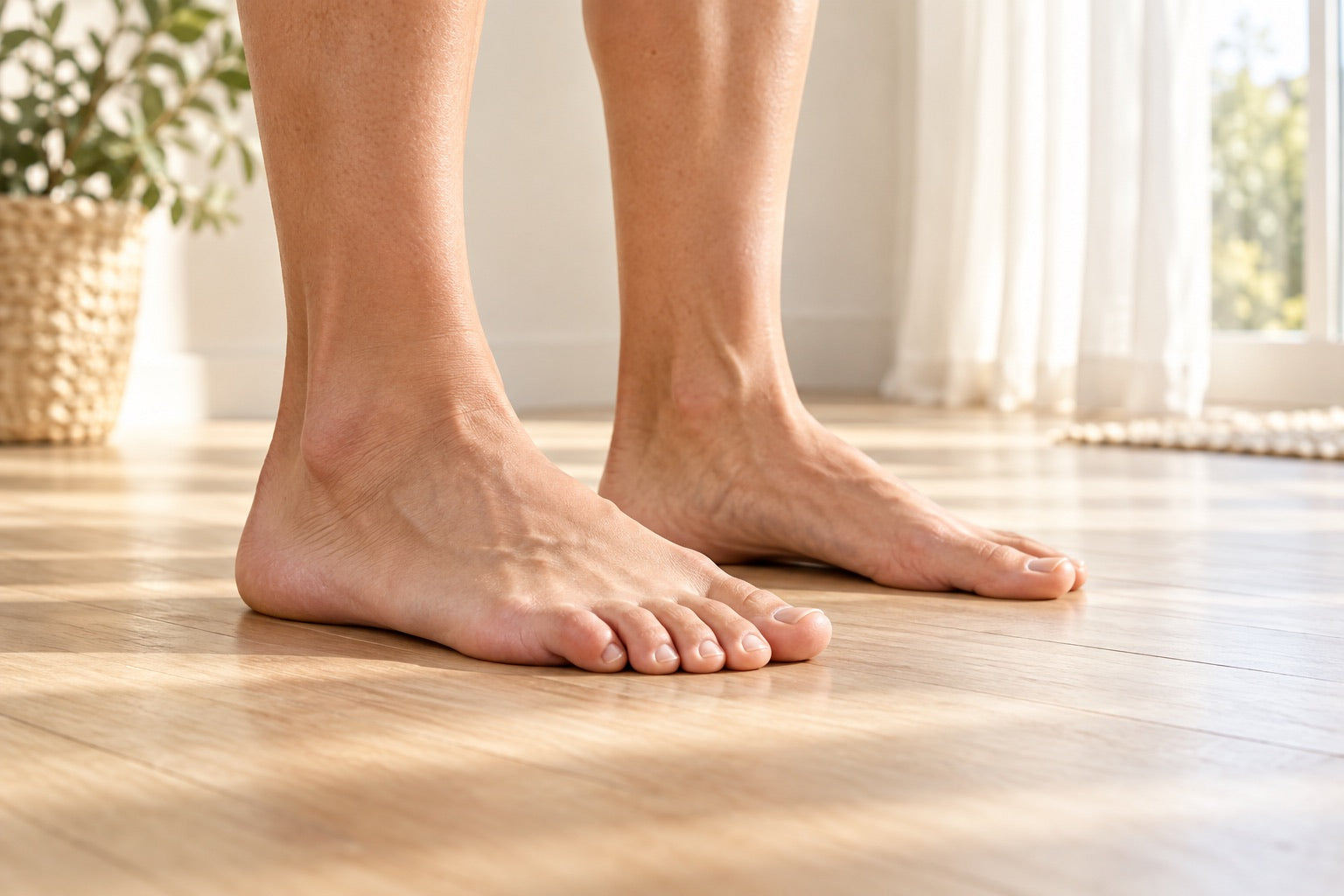
If you're past 50 and still moving — walking your daily loop, lifting a few times a week, chasing grandkids, getting out on the trail or the course — you're doing the single most important thing for how the next thirty years feel. The research on this is unambiguous and only getting stronger: staying active is the closest thing we have to a longevity drug. Every bit of strength training, every brisk walk, every flight of stairs you take instead of the elevator is a deposit into a body that will pay it back as independence, balance, and resilience later. Nothing here is an argument to slow down. If anything, it's the opposite.
But a landmark study that tracked people for nearly half a century recently put a sharper point on something most active adults never think about: physical capacity doesn't fade evenly, and it doesn't wait until you're old to start. Some systems decline earlier and faster than others — and the small muscles in your feet are among the first to quietly lose ground. The work you're putting in is real. The blind spot is that the foundation you're standing on is eroding underneath the rest of your fitness, usually without a single symptom until something starts to hurt.
What the 47-year study actually found
Researchers at the Karolinska Institutet recently published one of the longest-running looks at human physical capacity ever assembled — a 47-year longitudinal study[1] following a general population across nearly five decades, published in the Journal of Cachexia, Sarcopenia and Muscle. The headline most people took away was sobering: strength, aerobic fitness, and muscular endurance begin slipping around age 35, and the rate of decline accelerates with each passing decade. The slope gets steeper the longer you wait to do something about it.
But the same study carried a far more hopeful message, and it's the one worth tattooing on the wall of every gym: adults who became active later in life still improved their physical performance — by up to 10 percent. The capacity to adapt doesn't expire at 50, or 60, or 70. The body remains responsive to training stimulus deep into later life. What changes is the margin for neglect. When you're 25, ignoring a weak link costs you almost nothing. When you're 55, the same neglect compounds against a baseline that's already drifting downward.
That combination — early-and-accelerating decline, paired with a stubborn ability to rebuild — is the whole game for the over-50 athlete. It means the question isn't whether you can stay strong. It's which parts of you are quietly falling behind while you train the parts you can see in the mirror.
Why the feet fade first
Here's the part that rarely makes the longevity headlines. When we picture age-related strength loss, we think of big, visible muscles — the quads that struggle out of a low chair, the grip that can't open a jar. Those matter. But the foot is built from dozens of small intrinsic muscles that act as the active suspension system for your arch, and they are exquisitely vulnerable to the same decline — often earlier, because they get so little deliberate training.
The numbers are striking. Research measuring toe flexor strength across age groups found that older adults have roughly 27 to 36 percent less toe flexor strength[2] than younger adults, alongside measurable shrinkage in the muscles themselves. A separate body of work on age-related reduction of foot intrinsic muscle function[3] found that this weakness tracks directly with worse postural stability — the very thing that keeps you upright on uneven ground. The foot doesn't just get a little weaker with age. It loses a meaningful share of its force-producing capacity, and it loses the morphology — the actual muscle tissue — behind that force.
Why does this system fade ahead of others? Partly because almost no one trains it on purpose. You can deadlift, cycle, swim, and hike for years and never once give the small muscles of the foot a focused, progressive load. Modern footwear compounds the problem: a stiff, supportive shoe does some of the foot's stabilizing work for it, and a muscle that isn't asked to work gradually stops being able to. The result is a foundation that's been coasting for decades while the floors above it kept training hard.
The consequence isn't just sore feet — it's the whole chain
When the intrinsic foot muscles weaken, the load they used to carry doesn't disappear. It gets handed off. The structure most likely to inherit that overflow is the plantar fascia — the thick, passive band of connective tissue running from your heel to the base of your toes. Unlike a muscle, the fascia can't contract or actively absorb shock; it's a tension cable, and when fatigued muscles stop sharing the work, that cable takes the surplus. That's a big part of why plantar fasciitis is so common in active people over 50: the active suspension fades, and the passive cable picks up a debt it was never designed to carry alone.
The stakes climb from there. Weak feet don't just hurt — they make you less stable. Studies of toe grip force and fall risk in older adults[4] consistently find that people who fall have weaker toe and foot strength than those who don't, and that toe strength tracks with walking speed and balance. For an over-50 reader, this is the part that turns a foot conversation into a longevity conversation. The single biggest threat to a long, independent later life isn't a dramatic illness — it's a fall. And the feet are both the first sensors and the last line of defense in the system that keeps you from going down.
So the chain runs like this: foot strength fades first and fastest, the plantar fascia absorbs the overflow, balance erodes, and the risk of the one event that can end an active life — a fall and the fracture or fear that follows — quietly rises. None of it announces itself. It just accumulates.
"Just go barefoot and your feet will get strong" — the appealing trap
If foot weakness is the problem, the obvious-sounding fix is to strip away support and let the feet fend for themselves. It's an appealing idea, and there's a real kernel of truth in it: feet do get stronger when they're asked to work. But for an over-50 reader whose intrinsic muscles have already declined and whose plantar fascia is already carrying extra load, suddenly removing all support during high-load activity is exactly how you convert a manageable weakness into an injury. The tissue isn't ready for the demand, and the demand arrives all at once.
This is the same trap we unpacked in our analysis of why zero-drop shoes don't fix plantar fasciitis (and sometimes make it worse). Strength is built by progressive, recoverable stress — small, deliberate doses that the tissue can absorb and adapt to. Injury comes from stress that outruns capacity. The answer isn't to abandon support or to wear it forever; it's to train the foot deliberately in small doses and support it during the heavy, repetitive loading where unprotected tissue would simply lose. Those two strategies aren't in tension. They're the same plan from two directions.
How to protect foot strength after 50
The Karolinska finding cuts both ways, and the optimistic half is the one to act on: you can still build. The feet respond to deliberate training the same way the rest of you does. A systematic review and meta-analysis of intrinsic foot muscle training found that strengthening these muscles measurably improves foot function and dynamic postural balance[5] — the exact capacity that declines with age and protects against falls. Here's how to stack the levers.
Train the feet on purpose — in small, consistent doses. Short-foot exercises (gently doming the arch without curling the toes), toe spreads, slow heel raises, and single-leg balance holds directly target the intrinsic muscles. A few minutes most days does more than an occasional long session. Treat it like brushing your teeth, not like a workout you have to psych up for.
Support the heavy loading where the foot can't yet keep up. The hours you spend on your feet — walking, standing, on hard floors — are where a fatigued, age-weakened foot quietly hands its load to the plantar fascia. A structured orthotic insert restores arch support during exactly those high-load hours, so the passive tissue isn't carrying a debt it can't repay. You strengthen in the small doses; you protect during the big ones.
Keep doing the strength training that's keeping you young. Don't let foot concerns talk you out of the resistance training and walking that drive the longevity benefit. Lower-body strength, balance, and aerobic fitness are the headline protections — the foot work is the foundation that lets you keep doing them without breaking down.
Warm up the feet before big efforts. Tissue tolerates load better warm than cold. Rolling each foot over a ball and doing a few ankle circles before a hike or a long day on your feet gives the fascia a gentler on-ramp than going straight to full load.
Watch the early tells. Sharp, stabbing heel pain on your first steps out of bed — pain that loosens as you move and creeps back after sitting — is the classic plantar-fascia signature, not ordinary soreness. Catch it early and it's almost always a load-and-support problem you can manage. Conservative care resolves the large majority of cases (Cleveland Clinic)[6] when you address it before it becomes chronic.
The bottom line
The 47-year data delivers two truths that belong together. The decline is real, it starts earlier than you'd guess, and it accelerates — and the feet, rarely trained and quietly weakening, are often first to go. But the body never stops responding to smart stress, even decades in. The active life you've built after 50 is the right answer to aging. The missing piece isn't more effort or a different sport. It's noticing the foundation, training it in small deliberate doses, and supporting it through the loads it can't yet carry alone — so foot strength stops being the first thing to fade and starts being one more thing you've engineered to last.
Frequently asked questions
Does foot strength really decline faster than other muscles as you age?
The intrinsic foot muscles are among the most neglected in the body — almost no one trains them deliberately, and supportive footwear does some of their work for them. Research shows older adults have roughly 27–36% less toe flexor strength than younger adults, with measurable loss of the muscle tissue itself. They don't necessarily decline faster than every muscle, but because they're so rarely trained, the age-related loss tends to go unchecked and shows up earlier as instability and heel pain.
Is it too late to strengthen my feet after 50?
No. A 47-year longitudinal study found that even adults who became active later in life improved their physical performance by up to 10%, and a meta-analysis of intrinsic foot muscle training showed measurable gains in foot function and balance. The feet respond to deliberate, progressive loading at any age. The key is small, consistent doses — short-foot exercises, toe spreads, heel raises, and balance work — rather than occasional heavy sessions.
Should I just go barefoot to rebuild foot strength?
Some barefoot work can help wake up the foot, but stripping away all support during high-load activity is risky if your foot muscles have already weakened or you have a history of heel pain. That's the same mistake we cover in our zero-drop analysis: removing support during the exact activity that's overloading the plantar fascia tends to make symptoms worse. The better plan is to train the foot in small doses and support it during heavy, repetitive loading.
The WYATT takeaway
You're staying active after 50 — walking, lifting, hiking — but the small intrinsic muscles in your feet have been coasting for decades, and research shows they lose 27–36% of their strength with age while everything above them keeps training.
As the foot's active suspension weakens, the overflow load lands on the plantar fascia — a passive cable that can't absorb shock. Arch support erodes, balance drops, and fall risk climbs — the chain that turns "tired feet" into a real threat to staying independent.
The FCSS™ Pro is a removable structural insert that restores arch support exactly where aging foot muscles let it slip — so the plantar fascia stops absorbing the overflow and you can keep training the way that's keeping you young.
References
- Karolinska Institutet. Rise and Fall of Physical Capacity in a General Population: A 47-Year Longitudinal Study. Journal of Cachexia, Sarcopenia and Muscle, 2025 (reported 2026). sciencedaily.com
- Mickle KJ, et al. Effects of Age on Strength and Morphology of Toe Flexor Muscles. Journal of Orthopaedic & Sports Physical Therapy, 2016. jospt.org
- Age-Related Reduction of Foot Intrinsic Muscle Function and the Relationship with Postural Stability in Old Adults. Clinical Interventions in Aging, 2024. tandfonline.com
- Toe grip force of the dominant foot is associated with fall risk in community-dwelling older adults: a cross-sectional study. Journal of Foot and Ankle Research, 2022. link.springer.com
- Huang H, et al. Effect of intrinsic foot muscles training on foot function and dynamic postural balance: a systematic review and meta-analysis. PLOS ONE, 2022. journals.plos.org
- Cleveland Clinic. Plantar Fasciitis: Causes, Symptoms & Treatment. my.clevelandclinic.org
Reviewed and approved by the WYATT MVMT Podiatric Care Team — backing every step with 35+ years of custom orthotic engineering.